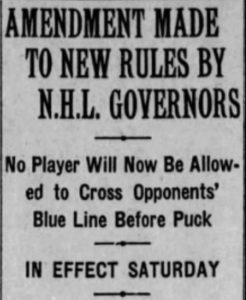
When the NHA and the NHL began, the later in 1917, the forward pass was forbidden. This was similar to the rule in rugby, the likely origin. The violation of this rule led to a stoppage in play, resulting in a face off from the point of the infraction.
The first noted easing of this rule came from the Ontario Hockey Association which allowed the defensive team to pass the puck forward within three feet of the goal, only where the puck rebounded from their goal.
The NHL then permitted the forward pass within the defensive and neutral zone in 1927. The rule was again revised in the 1927-1928 season to permit unimpeded forward pass, and in fact completely so. The league was then required to create a rule preventing an offensive player being permanently located in front of the opposing goalie. This led to the introduction of a version of the current blue line offside rule in late 1929.