Check this out. It is the oldest known video of NHL from 1925. The voice of the narrator is worth it alone.

Even Morons Can Change
Check this out. It is the oldest known video of NHL from 1925. The voice of the narrator is worth it alone.
It is hard to believe that in the season 2016-2017 the two conferences of the NHL had differing numbers of teams, 16 in the Eastern Conference and 14 in the Western. The play-off criteria were the same. Completely bizarre. When did you ever hear a word from any commentator on this subject. The introduction of Las Vegas modestly corrected this inequity to 16 vs 15. Still hard to imagine. The new franchise in Seattle finally evened the two conferences.
The playoff format was and is the same in the East and the West. The first three teams of each Division qualified plus 2 wild cards. Hence in 2016-2017 in the West, each Division had 7 teams, whereas the Eastern equivalent had 8. It then became 8 and one with 7 with Vegas and even at 2023-23.
Only two assists are recorded for any goal scored, which is fair enough, The intent of counting assists is to record play making ability, also a good idea, This being said, the NHL records an assist for a scoring attempt which is blocked or otherwise deflected by the goalie, which then, obviously unintentionally, may bounce to another attacking forward who then scores.
So how is an assist? A failed scoring attempt somehow is adjudicated to be a pass to a team mate to yield a goal ? Bizarre once again.
On a similar theme, if A passes to B who passed to C who scores, the points then are (1) assist to A, (2) assist to B and (3) goal to C. That is easy enough.
So if A passes to B and B returns the pass to A who scores, why does it not follow that the points would be (1) assist to A, (2) assist to B, and (3) goal to A. For some reason, A is limited to the point for a goal. It should theoretically follow, that if A’s pass could be an assist when C scores, it should be an assist when A scores. It was the same play making ability that led to the goal in either instance.
There is a logical reason why the play is not whistled down when a penalty is called. Presume the innocent team has a break away or some other visible scoring opportunity. There would be a incentive for the opposing team to take an immediate penalty to stop this possibility if the play was to stop immediately upon the occurrence of the infraction.
For that reason, the rule requires the offending team to have puck possession before the play is stopped. Because of this rule, the innocent team often pulls its goalie for an extra attacker to take advantage of this circumstance. The thinking is, that it is safe to do so, as the offending team cannot possibly score due to the immediate ending of active play.
This does not, however, mean that there is no risk, Occasionally the innocent team has scored in its own empty net by an errant pass, deflection or some other unanticipated event. The point of all this is that the innocent team, when choosing to pull the goalie, takes advantage of the need for the offending team to require possession, and hence assumes some contextual advantage of the rule and also some potential liability.
But the real issue is this – when the innocent team scores, whether or not it chooses to remove the goalie, the penalty call is rescinded. Why on earth should that result follow ? There was still a penalty call, The goal has not reversed that. It is not the same as scoring in the course of a penalty being severed, This is simply bizarre.
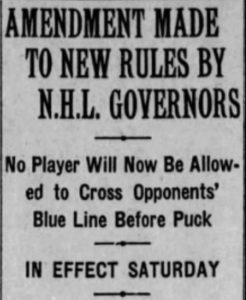
We all know the purpose of the blue line offside rule is to prevent the attacking team from passing to a player over the defending team’s blue line. Hence the rule has developed that the puck must cross the blue line first, in advance of any player including the puck carrier. This is illustrated in the diagram below showing an offside pass from LW to C, where C is over the blue line and hence offside.

The problem becomes the NHL’s interpretation of the rule. Presume the offensive team’s puck carrier is approaching the defensive team’s blue line and further than one of his players is behind this blue line and is trying hard to skate over the blue line, that is, in the opposite direction. We now have a situation where the play will be whistled offside if the second player cannot be outside the blue line prior to his teammate crossing it.
That is just a stupid view of the rule. Technically speaking, yes there will be a player over the blue line in advance of the puck. The offside call will simply slow the game down, The solution is to make the second player an “ineligible receiver”, so to speak. That is, this player cannot receive the puck until he clears the blue line. The play will then continue and the game will be uninterrupted by a stupid delay.
Interestingly if the puck is shot into the defensive end, as opposed to “skate in”, without an icing call, an offensive player caught behind the blue line is allowed to exit and stay onside.
For a review of the history of the forward pass and the need for the blue line offside rule, see the well written comprehensive article on this subject.
When the NHA and the NHL began, the later in 1917, the forward pass was forbidden. This was similar to the rule in rugby, the likely origin. The violation of this rule led to a stoppage in play, resulting in a face off from the point of the infraction.
The first noted easing of this rule came from the Ontario Hockey Association which allowed the defensive team to pass the puck forward within three feet of the goal, only where the puck rebounded from their goal.
The NHL then permitted the forward pass within the defensive and neutral zone in 1927. The rule was again revised in the 1927-1928 season to permit unimpeded forward pass, and in fact completely so. The league was then required to create a rule preventing an offensive player being permanently located in front of the opposing goalie. This led to the introduction of a version of the current blue line offside rule in late 1929.
The NFL has it right preventing any game from ending on a defensive penalty. This makes perfect sense. The defending team should not be able to take a penalty preventing a touchdown or other scoring opportunity at the end of the game.
The dummies at the NHL have yet to figure this one out. Suppose with 30 seconds left, a vivid scoring opportunity emerges, at which point the defenceman takes a two hander slash to the shins of the apparently ready goal scorer, denying the goal. What is the penalty then ? A 30 second or whatever man advantage. It makes zero sense. In fact, this status of the rules provides an incentive to the defending team to do just this. You would expect after 100 years, give or take, the Rules Committee would have thought of this. Apparently, not so much.
The rule should be amended to (1), at the every least, extend the game by the length of the penalty, or (2) even better, allow the referee to award in his discretion a penalty shot or (3) in a clear case of malfeasance, declare a goal. The last option seems excessive, true, and should be used sparingly and in glaring moments of unfairness, but the first two are very reasonable.