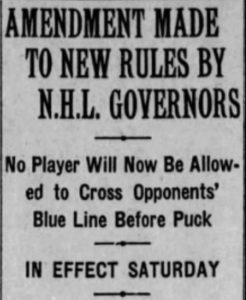
We all know the purpose of the blue line offside rule is to prevent the attacking team from passing to a player over the defending team’s blue line. Hence the rule has developed that the puck must cross the blue line first, in advance of any player including the puck carrier. This is illustrated in the diagram below showing an offside pass from LW to C, where C is over the blue line and hence offside.

The problem becomes the NHL’s interpretation of the rule. Presume the offensive team’s puck carrier is approaching the defensive team’s blue line and further than one of his players is behind this blue line and is trying hard to skate over the blue line, that is, in the opposite direction. We now have a situation where the play will be whistled offside if the second player cannot be outside the blue line prior to his teammate crossing it.
That is just a stupid view of the rule. Technically speaking, yes there will be a player over the blue line in advance of the puck. The offside call will simply slow the game down, The solution is to make the second player an “ineligible receiver”, so to speak. That is, this player cannot receive the puck until he clears the blue line. The play will then continue and the game will be uninterrupted by a stupid delay.
Interestingly if the puck is shot into the defensive end, as opposed to “skate in”, without an icing call, an offensive player caught behind the blue line is allowed to exit and stay onside.
For a review of the history of the forward pass and the need for the blue line offside rule, see the well written comprehensive article on this subject.